Saturday, November 2, 2013

Brushes on a budget


While I was looking for some small, inexpensive stencil brushes for a moku hanga class I taught a few months ago, I found some cheap, Chinese, bristle brushes for about $3.50 each. These were disappointing. They were too stiff and shed hairs like crazy. The students had a really hard time getting any decent coverage and they left lots of very streaky marks on their prints. So I had almost abandoned them as a waste of money. (Worse since I had twelve students and so was left with 12 brushes...).
But a few weeks ago while I was prepping some new brushes I had gotten from Japan I decided to try singeing and shaping a few of these to see how they would perform if I modified them the way I do my good brushes. Surprise, surprise they worked pretty well; on small blocks, they covered well and now that they were singed and the hairs split/tapered they spread out the color evenly enough to use them for my last print--and well enough that my "Pinwheel" print was printed using just these brushes for the color blocks.
  
before and after
Pretty good color coverage using these cheap brushes AFTER prepping them.
While almost worthless as purchased--after a trim with some scissors and a brief stint singed on a hot plate and then worked on a sandpaper "sharkskin" it's a whole new brush.

Nowhere near as soft or well-made as my professional brushes and much harder to clean but at $4.00.....I can afford to spend more time washing them...and for beginners they're more than adequate.

So after this small success I looked around the house for bigger, better quality Italian brushes:
Italian, "pura setola" brushes
I found these two brushes that were designed for painting wooden trim--the one on the left has been trimmed, singed and then worked on a piece of sandpaper to soften the tips. They too worked pretty well for moku hanga. They were a bit too soft...but color blends were decent and they're pretty serviceable if you don't need perfectly smooth coverage.

So, emboldened, I headed out to the craft store nearby that caters to the faux finishes and interior house painters....it turns out that Italy is also a pretty significant brush making country and the OMEGA line of brushes included lots of different sizes and types of bristles.

Unfortunately, they're all marked "Pura Setola" which I can only loosely translate as animal hair.....some were clearly pig bristles, some made from horse tail and some are probably ear and back hairs....some are beige and soft, some are white and stiff and some are black and coarse.


I decided to shell out some real cash and I bought two fairly big brushes and one small detail brush. They set me back $5.00, $12.00 and $17.00for the larger brushes that if they were good Japanese brushes would have each cost over $75.00.....
The above photos show the brushes as purchased (with long, flexible black hairs), then after singeing the brush to a soft curve, and lastly with the brushes finished after trimming them with scissors, singeing them on a hot pie tin over a gas flame and then worked across a strip of sandpaper for 20 minutes.
These look and feel like horse tail...they're fairly coarse....definitely a little coarser than my professional Japanese brushes.
They look pretty good.
They feel pretty good.
Definitely a little coarser and stiffer than my other brushes and the handles will be harder to use than the "shoe brush" maru bake I like to use.

I'll let you know how they work out: I'm still working on 4"x6" prints and will have to break out a big block of wood to test these brushes to see how they do.

I will say that while in the brush shop I also picked this up:

 I used it during my last paper sizing trials....and I'll post about it soon.

Thursday, October 3, 2013

Girandola ("pinwheel" in Italian)--finished print.

Pinwheel, 5"x7" moku hanga woodblock print


Well, this was conceived as a little study or exercise and I was hoping it would get me moving again and it worked well for that purpose.
It got me carving and printing again.
I was able to try using a little jig (floating Kento) to allow me to use the entire block for printing which was something I had wanted to try again for some time.

It allowed me also to use a new paper--Mura Udabon (from the Japanese Paper Place) a 100% Kozo washi that is internally sized and has a pronounced wood grain (the paper is dried on wooden boards and retains the texture of the boards they were dried upon.

There is a lot of overprinting despite the apparent simplicity of the print.
Each trapezoid is printed at least 2-3 times and there are subtle bokashi printings to the vanes/colored wings of the "pinwheel" shape.
I only printed 5 copies (I was proofing really) so I have to decide if it's worth going back to print any more, much less a real edition.

Sunday, September 29, 2013

Pinwheels No. 3

Working proof, Mura Udabon washi

Working proof, Fabriano Artistico 90lb


Had a good day today and with the rain coming down I was able to get in a solid block of work in the studio today.
 I'm test printing the blocks for the little pinwheel abstraction print.
They are printing pretty well but I'm especially pleased as I'm printing with my two handmade barens and they've been working pretty well.
The 14cm baren I made that was a bit too big and "weak" is proving to work very well for keyblock printing, it's wide surface and softer twists seem to work well on the linework.
My "harder" 11 cm baren with the mat medium painted over the braided cord is working pretty well too. It's not as stiff as my Murasaki medium baren and being smaller is more apt to pick up stray ink but on this scale and with these fairly soft, thin papers it's been working great for a $10.00 baren.
The lower of the two is on Fabriano Artistico and the yellows were just printed  (two layers) and I'm pretty happy with the coverage..there is a little mottling but that's due to the watercolor paper more than the baren.  The upper copy is on Mura udabon; a nice beige handmade Washi of medium weight and if you look at the yellow and greens the coverage is again pretty smooth (the purple was deliberately printed lightly to get a little "texture"...).
I'll work on getting a lively orange in one of the trapezoids and deeping the textures/complexity of the other surface colors tomorrow.  Hope to wrap this up in the next day or two.

Wednesday, September 25, 2013

Pinwheel #2

5"x7" mixed-media: woodblock, watercolor and pen-and-ink

I printed and pasted down four of the little grid prints that are the basis of this small painting/drawing and while I was waiting for them to dry,  I hand-colored this copy that was printed on etching paper.

This is getting closer to what I have in mind.
A little too "Mondrian-esque" but I'll be printing with dirtier colors and the printed inks always look different  (besides he NEVER used diagonals or browns.......it was a kind of dogma thing.......to which I am not constrained.).

Hope to carve and print in the next 1-2 days as this is meant to be a stimulus and not a diversion.

Monday, September 23, 2013

Pinwheel


Pinwheel, 5"x7" mixed media (woodblock, pen and ink, watercolor)

I've had a backlog of print ideas for some time but I am still not yet at the "ready to carve" or print stage with any of them. But I've been itching to get back into the studio and just make some marks.
I came back from the US with a box of 4" x 6" shina blocks and I've decided to try and use them to make some quick and simple prints based on simple geometric shapes and objects.
The goal is to try to approach the rapidly drawn pen line of my sketches and later fill them in with some broad color blocks.
Here is the proof of my hastily drawn and quickly carved trial block.
I printed the uncarved back of the block in pale yellow, then the front in dilute sumi ink on Japanese paper.

Then just to get the colors flowing, I took one of the proofs on Magnani incisioni etching paper and added some pen and ink, and some watercolors.........
Not really where I wanted this to go but I'm moving forward again and that was the point.
I will carve some color sections and reprint a few of these on good paper....just to see how loose and
"sketchy" I can keep this. Meanwhile, I'm fleshing out what will be my next "real" print and hope to have a finished drawing ready for wood soon.

Wednesday, July 17, 2013

Day Job


When I'm asked what I do, I'm always hesitent as to how to reply.
Do you mean what do I get paid to do? Or what do I spend most of my time doing? or what would I be doing if I didn't have any family responsibilities?
What do I do well? Or Just for fun. Just for me?
What do I do that's important, or frivolous. Selfish. Selfless. 

What did I do yesterday, or today, or last month...or tomorrow?
No answers here.
I joke that I've aleady had three or four careers...

I worked in the clinic all day yesterday and will be working almost every other day through the Summer before we head back again to Italy.  And since my free time now is spent keeping up with the medical world--reviewing charts and current practice there's no time now for painting or printing. We still commute between two worlds. Italy where I get to be a dad/farmer/printmaker/artist and the US where I jump back completely into the medical world of patients, long shifts and the desire to make people well and the everpresent fear of making a mistake or missing something serious.

But we will head back to Italy in September:
The boys will be back in school and Fall chores in the fields will beckon--maybe there will still be time to put in strawberries or seed a cover crop in the bottom fields or squeak in some spinach and lettuce to overwinter.
Then maybe I'll have a moment to pull out my sketchbooks again.
I have some wood planks waiting and a few ideas I've been kicking around for years that I've been hoping to get onto paper eventually.


Wednesday, July 3, 2013

The Three Graces: Glad, Hefty and Kirkland

The Three Graces, moku-hanga woodcut; 8.5"x11.25" on Echizen Kozo washi; edition 12


I don't think it was irony or wry cynicism that led me to call my last print the Three Graces;
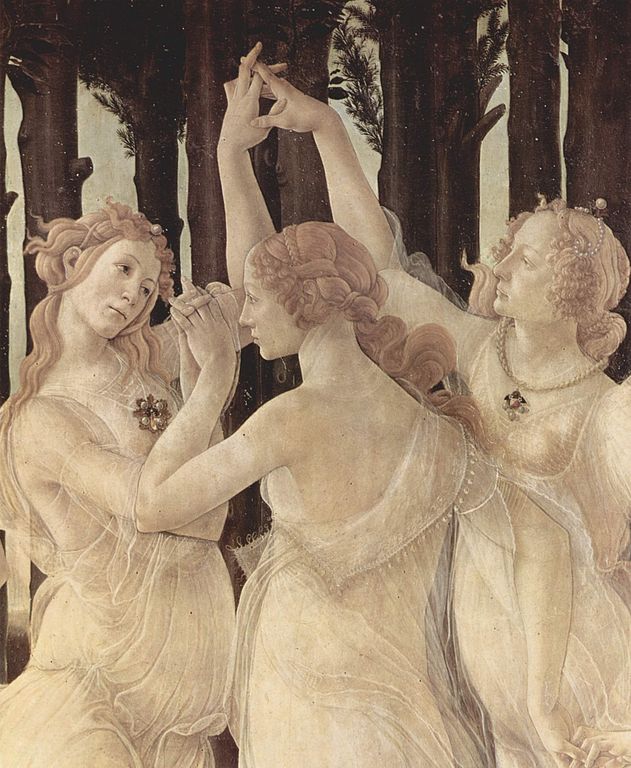
I think instead it really was just the way the three sets of hands and tilted heads rose to the surface from the memories of art classes of long ago and art visits of more recent times and reminded me as I sketched the three bags that would become the subject of this print.  It was only later that I realized how apt a title it was. 


Agliaia, Euphrosyne, and Thalia; they represent the three Greek Charities or Graces;
They were the goddesses of joy, pleasure, grace, beauty, festivity, adornment, dance, and song. The daughters of Zeus and sea-nymph Eurynome-- they were also the handmaidens of Hera and Aphrodite, and hence, among other things the protectors of vegetation.
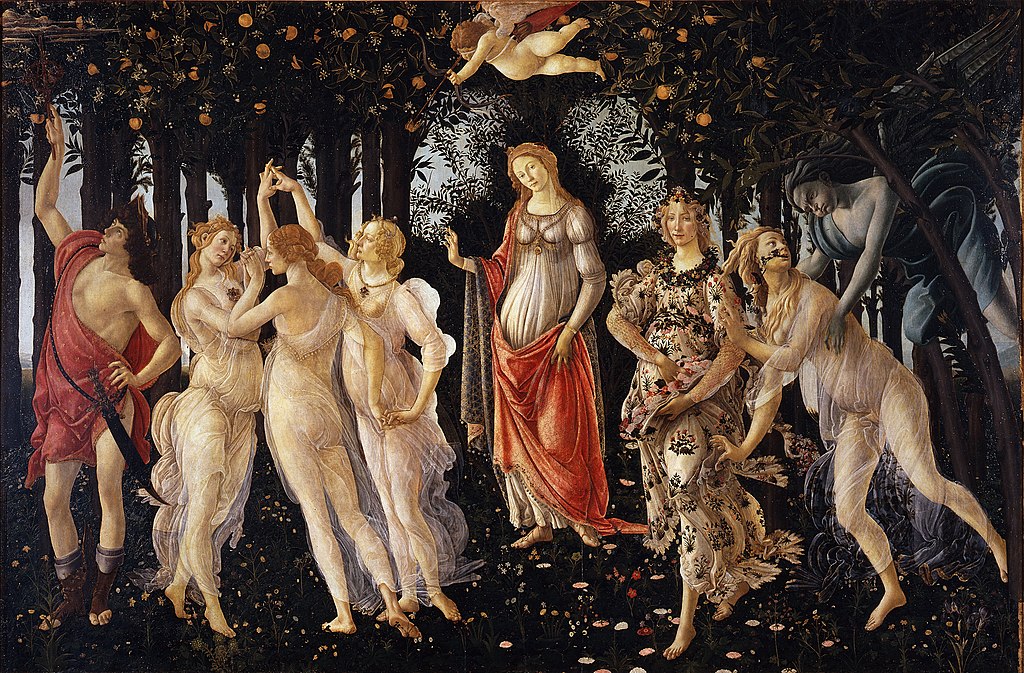
Here's the entire painting, from the Botticelli room of the Uffizi gallery in Florence:


It's big, beautiful painting and enigmatic in the way that lost symbols often are.
It's a complex work, and it's symbolism and thematic origins  are still debated but it is reproduced everywhere and these three young women adorn posters, calenders, postcards, plates, trays, etc. and have become part of every Florentine's collective memory.
(Once, after a kindergarten class field trip; Sami stood in front of it and spent 15 minutes explaining to his grandmother (and a gathering of open-mouthed, American tourists) the complex symbolism and identity of the various figures: Zephry, Chloris, Venus, Eros, Mercury, the Three Graces, Flora.....))

But we've come a long way from Classical Greece or Renaissance Florence.....
I'm an American and can't claim to come from a culture that is synonymous with Art, or Creation, or any kind of Charity.
As one of the largest consumer societies in the world, we are responsible for the bulk of the consumption of needless crap, and the resulting mountain of packaging, paper, plastic wrap, cardboard, starch peanuts, styrofoam, injection-molded plastic all designed to safely envelope, package, transport  stuff we never really needed into our homes and lives.
 
So instead of Grace, Joy, Mirth and Song we have Glad, Hefty and Kirkland. And we'll be remembered, perhaps in 2000 year's time by the accumulations of refuse we've left behind rather than some painted panel or chiseled relic.