Showing posts with label garden. Show all posts

Monday, January 16, 2017

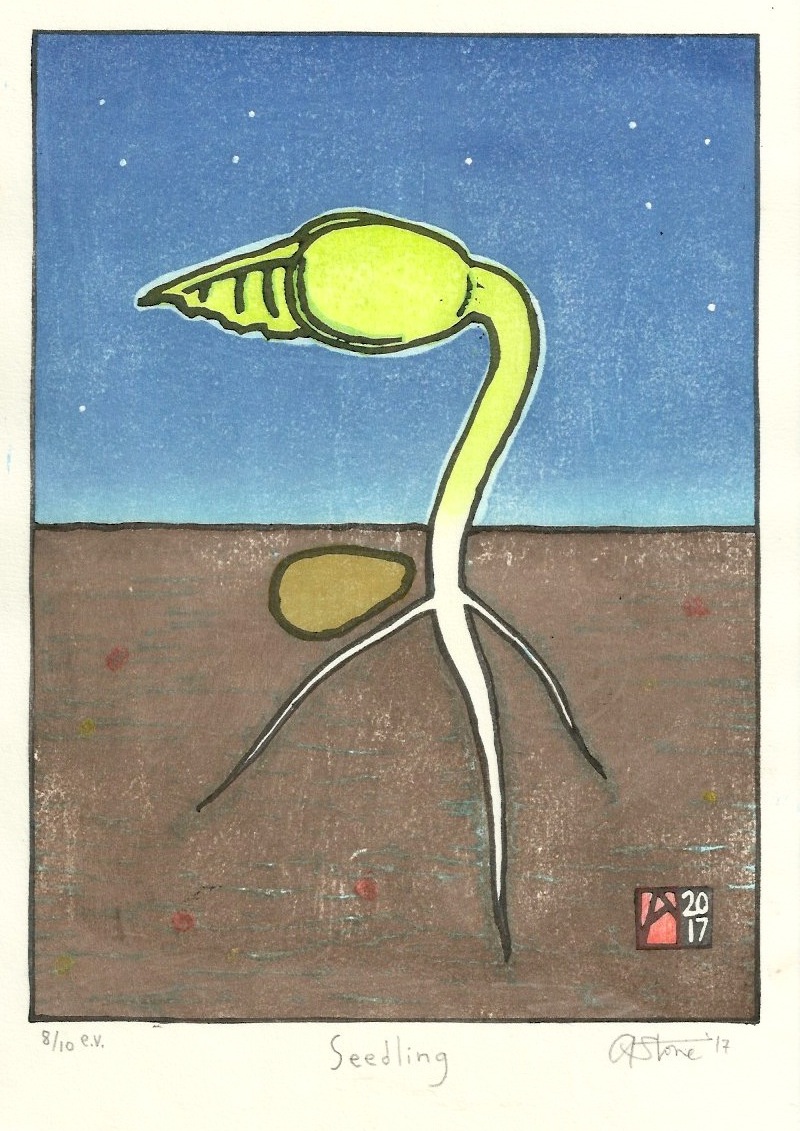
Seedling


There are some plants, pumpkins and squashes, for example, that grow faster at night,  in the hours just before dawn.
And there are some seeds, that without a period of darkness and an absence of light, won't germinate at all.

It is winter and the Solstice has just passed. The shortest day is now history but the nights are still long and cold and I awake to darkness and frost and brittle grass. The winter wheat the neighbors planted went in in November and will put roots down into the cold earth--as they're more hardy in the cold than the other seeds--and will gain a head start that will mean a good crop and grain for bread and pasta in a June and July that are still a distant dream.
Fava beans and peas are also already in the ground and have sprouted but just sit there,  with leaves limp and sad in the cold and damp as they will patiently wait for lengthening days and warmer temperatures to jump up and climb and unfurl leaves and tendrils.

I'm a gardener and therefore an optimist by nature.  But I'm frightened by the wind and chatter now.
Things are changing that the wise farmers didn't see coming.
There are seeds that have been planted for hundreds of years that are now gone, "disappeared" by companies that bought seed houses and catalogs and made them vanish or had them re-patented so they can no longer be saved and sown by the frugal or good farmer.
And they don't tell us but the water is dirtier than it's supposed to be and the air has particles in it that are too small to be measured easily and so are declared "well-below measurable limits".  So even my "organic" garden isn't. No more than anything alive is now free of radioactive isotopes from the atomic tests, bombs and nuclear disasters.
 And now the chemical and oil and pharmaceutical and pesticide and seed and food companies all become one and soon it will be illegal (maybe I'm paranoid) to save seed, or plant "unapproved" varieties, or grow vegetables on unreported plots--and all in the name of "food security" or to fight "bioterrorism".
I watch the news and I read the papers but for the first time that I can remember,  the people in charge want MORE oil exploration and pipelines,  more mining and more ocean drilling but fewer environmental protections for the air and water or labor regulations that guarantee worker and public safety.  They want no regulations to hamper business models that can be profitable only if they can shift the cost of clean up and waste removal to a distant public till and that are instead now encouraged to plunder and multiply while laws are passed that protect them, rather than us,  from liability for environmental damage or pollution.

I have never been a political activist but now I have no choice. I have to join the fight to keep them from poisoning the wells, darkening the skies and making a lifeless, plastic gel of what was once the water of life or stealing the birthright of future generations, the germplasm of all the crops that have ever been sown in soil worked by honest men and women. So I am attending meetings and writing letters and supporting those that are still working to conserve and protect but I will also go back to my little plot of soil.

So I will plant a garden this spring and record in a diary the day the first anemonies flower or the grape buds swell, the day of the first asparagus on the table and the first and last of the English peas.  I will plant some of the old varieties and grow food that the peasants knew and flowers that have different names in different lands. Some we eat, some I draw. As farmers have done for longer than memories can recall, we eat the stunted and challenged plants. For the best plants, strong and defiant, are allowed to set seed are not eaten but saved. They are saved for next year's seed.  We select out the best, the ones that thrived in my soil and today's climate to plant next year and for the year after that, and the one after that, and so on, or so we can hope.
It is dark outside but not yet night.
I wonder what will come up in the garden this year and what will be there to harvest.

Notes; "Seedling" is a moku hanga, watercolor woodblock print. 8.25" x 11.7" and was printed from 4 blocks with 8 separate color impressions on handmade Japanese paper (Shin Hosho). e.v. 10 copies.


.


Thursday, June 9, 2016

A Day Late. A shell pea saga and metaphor for life.


A day late.....
As they used to say in New England. "old peas are bad business".
The harvest window for fresh shell peas is very short. Too soon and they're really tiny (but very sweet). Later, as the peas start to fill the pod, the pod is still shiny and green and the peas are tender and sugary. Too old and they get hard and starchy. There's a brief period (1-2 days) when they're perfect. Plump but not crowded and still round(ish) and tender and sweet and full of the flavor that is totally "Spring". But if you procrastinate even 1 day to pick them you can taste the difference. More than that and there's the internal debate as to whether you should pick them at all.  It's a dilemma for the farmer as the yield when they're small is really, really low, but if you wait just a couple more days, they're big and fat and (when you sell by the pound) almost profitable (but much less tasty).  But here they sell for 6-7€/kg (about $3.50/lb.) and if they're picked when they're small, you need a really long row have enough to harvest. Add to that the fact that peas needed to be sold the day they are picked or the sugars in the pea turn to starch--in the same way that the old-time corn varieties need to be cooked and eaten right away and it's the rare farmer than makes a profit selling shell peas.     These are Progress No. 9 Dwarf Shell peas. Planted in early Spring (rather than the Fall as is the usual custom here) AND Picked a few days AFTER that fleeting, perfect moment.


Many market growers now grow only Sugar Snap or similar Snap Peas.
They stay sweet longer and as the whole pea is edible it's a much better deal for the farmer and the consumer. (easier to pick, much longer harvest window and better value to both). 
The really hard ones, already a pale yellow and corrugated I left in the field.

Since I grew these we eat them. Cooked with some fresh garlic, some salt, and a pinch of sugar (to make up for what isn't in the peas any longer) they were still pretty decent.  Or braised with the last baby artichokes, a little wild fennel frond, some lettuce leaves and a few stray asparagus spears and they still vanish from the table in a flash, even if they're not so pretty.

P.S.S. This is why frozen, baby peas are probably a good value.  They're picked all at once by a combine and immediately blanched and frozen and at the scale they're grown commercially, much less costly to buy for a product that is usually of high quality (baby peas) and better than you can find  in the market unless you have a farmer that's better organized and attentive than I am.
 

Sunday, May 17, 2015

Takenokawa----that time of year again


This is a new bamboo cane and it's growing almost 1' a day.
Ah Spring, when the lusty thoughts of young men everywhere turn to takenokawa.
The bamboo is growing at the rate of a foot a day and that means about once a day, the thin, tough culm that surrounds the growing segment is dropping off too.
I noticed new bamboo shoots in the garden last week and knew it was time to go hunting.
I have a large paper bag as I won't need anything else.


Thank you spring; you have replenished my supply of baren-leaf covers (barengawa) for the year.
(This stand of bamboo has canes that range from 1" to almost 3.5" in diameter....the largest will easily open to 14-15cm when dampened and stretched and a great many of the smaller ones will stretch to 12-14cm...enough to cover my home-made barens).  It rained yesterday so I'll let these sit outside today as there is a drying wind and I'll put them away later before it gets damp in the evening.  I'll check again in a few days as there will be as many again littering the ground.
I recommend you go visit your botanical garden soon with a shopping bag.

Wednesday, March 18, 2015

Primroses/Primule-March Etagami.


"Spring primroses say, "Hello, Hello".
A little over a year ago we went to the mountains in the Appenines near Genoa.
It was late spring and very damp and there were wild strawberries in bloom (but no fruit) and lots of low yellow primroses flowering.

I dug up a few of each and potted them when I got home.
It's now a year later and the primroses, despite almost complete neglect, are in full bloom.
They are a pale yellow and almost glow in the dark in the early morning and late evening when everything else is dull gray and brown.
Since they are such a local symbol of early spring and seem to me so cheerful and optimistic.
So I chose my vase of transplanted mountain yellow primroses as the subject for my March etagami.


Wednesday, January 21, 2015

Narcissus

Narcissus, 7.5"x10" moku hanga--woodblock print. 2015

When I was in college, I shared an apartment for some time with a young woman who was working to help pay for her education. She worked in the local florists after school and she would bring home some days bunches and bunches of flowers that were a little too old to sell.  It was a good time in my life and the flowers of New England sat on the windowed kitchen in a Main street walk up.
The shelves would fill with Mason Jars and water glasses full of iris and daisies, tuberose and narcissus and we would enjoy the waning color and scent as the flowers slowly faded from a little tired to past withered.  We were bright and full of promise and so it wasn't very long before we had to leave that place and moment for other places and other things.

Thirty years later, I plant bulbs in patio pots and outside under the trees.  In the fields around us are nearly-wild double daffodils, tulips and nodding onions, narcissus, jonquils and hyacinth that will usually start to bloom in late winter or early spring.  And when they bloom, flags of color against the cold-tired fields of grass and mud, I am reminded of the waning flowers, and the kitchen, books and tea, and the woman I knew, and the distant promises we made, and sometimes kept, when we were flowers too.

Thursday, March 13, 2014

Unexpected Treasures (Truffle)


This Saturday, while I was up in the trees pruning.  Sami called out...from afar......"Dad, I think we found a truffle....".

Clip, clip, clip. I kept on pruning but called back over the trees.
"I don't think so Sami. They grow underground and you need dogs or pigs to find them." I replied.
"Oh." he answered. "Well there's this thing with scales peeking out of the ground....I'll just dig it out.
He was out playing with our neighbor and I didn't hear anything for a bit.

A few minutes later he comes up to the base of the ladder (I'm up in the tree).
"Here. Look."

So I glanced down.
 It took about one second.

"Yes. OK. You're right.  That's definitely a Truffle." Then after a pause,
"Can you show me where you found it?"
So much for hounds. This is next to our driveway!

This is a staged photo; The truffle was put back where they dug it out to show me.


And sure enough. They had found, just peeking out of the wet/clay soil the tip of a black truffle.
Now there are HUNDREDs of varieties of truffles. Some are really good. Some are not. This smelled of earth/a bit of mushroom but did not have the really strong truffle smell of the highly prized white ones. But it didn't have the inky or phenolic smell of the bad ones either.  Tan inside. Edible. A Truffle.

I think I'll try to have someone with a truffle hound come over in the next few weeks.
Maybe there are more.


Wednesday, January 22, 2014

Etagami


"Winter Vegetable; Indoor color when flowers are few" 4"x6" watercolor and sumi on Washi.
I joined the local Japanese cultural association; LAILAC which aims to introduce and foster an understanding of Japanese arts and culture to Italians. There was a large fair in December with demonstrations of dance, ikebana, drumming, cooking, calligraphy and a special section set up to show people the art of ETAGAMI; simple drawings of everyday life, usually coupled with a short phrase or comment that are shared with other--usually through the mail.
They are painted on weakly-sized washi using a brush held vertically from the end so perfect control is impossible and the inevitable bleed of some of the ink and color into the paper are part of the appeal.
So, with instruction, anyone who wanted to participate was allowed to draw a quick sketch with sumi and paint in colors using watercolors.  I left mine with the hosts but suscribed to their ETAGAMI exchange, which would pair me up--like a pen-pal--with a Japanese participant to exchange monthly Etagami. They are handling the actual bulk mailings and the only requirements were that the simple phrase to accompany the drawing be written in JAPANESE.

Here's the Etagami I received yesterday from Japan.

I can't read it and haven't had time to have it translated but it is a cheery orange or mandarin.


In keeping with the Season (and because I wasn't ready to deal with another horse) I went to the photo I took a few weeks ago of one of the Red chicories that are so loved here in the Winter.


The image at the top was the Etagami I made to send to Japan. It was my 3rd try (controlling the bleed wasn't easy....) and writing the Japanese using the brush too was as awkward as it must look from my calligraphy.
Here too is the preparatory sketch I did in my sketchbook with the English version of what I hope I wrote in Japanese (Thanks to Googletranslate I was able to play with different phrasings to get something I could write.).

I love watercolors and will be doing more of these. Hopefully I'll get more skilled.
If you Google: ETAGAMI and look at some of the examples,  there are some that are really phenomenal.


Wednesday, May 4, 2011

Roses

The Pruner; Rose Garden, Exposition Park, L.A. 2011
My son made it into the State Science Fair and we drove to Los Angeles for two days of judging and exhibits. While he was explaining his project to the judges I went outside to explore the adjacent Rose Garden.
Exposition park has a very large formal garden planted to separate beds; one variety to each bed. So there are rectangles of white, red, yellow, mauve, purple and orange flowers. It was too hot to catch the scent unless you pushed your nose deep into the blossoms.
As I waited outside on a shaded bench surrounded by hundreds of roses and a fountain
and the Beaux-Arts Style architecture; I pulled out my always-handy but rarely-used field sketchbook and colors.
It was early morning and there were workers out pruning and watering.
This man was heavily built and had a baseball cap, slate blue outfit and rust colored apron and white work gloves as he went about the beds deadheading and pruning out the still in FULL bloom May blossoming.

This is somewhat compressed and made up. I did sketch the general layout but as I filled in the color I sort of abandoned the careful layout if favor of flowing greens and spots of color.

It seemed to be favorite walking spot of elderly Korean women with colored umbrellas (for shade--it was 90F degrees yesterday) and big sneakers and white cotton gloves.
They all stopped to look over my shoulder but were too polite to say anything.
I like the riot of colors even if I had wanted the man to be lost in a sea of flowers but he ended up being the focus and subject.

Thursday, July 22, 2010

Poppy 2


Well, salvage time. Mom's birthday and I didn't send flowers. (I didn't forget, she was in Norway! Cruising her way around the fjords).
This was the first pull off of Big Blue; it printed very spotty, the red was all wrong and the green dried on the plate and didn't print onto the dry paper.
So, watercolor to the rescue.
Daniel Smith artist color and some pure pigment brushed into the petals to get that vibrant red I wanted. Lots of greens mixed both on the paper and palette.
It's a little overworked and the drawing's a bit off. But it's way better than it was before. Hope I can get it dry and in the mail before the ship returns to port.