Sunday, February 12, 2017

Moku Hanga. How My Prints are made.


Moku Hanga means simply "wood print" in Japanese so all woodblock prints are technically "moku hanga". However in the West, the term is used to refer to woodblock prints made using the Japanese method; there are individual blocks (usually one for each color), watercolor pigments and rice paste are applied directly to the block with brushes (instead of  a brayer and oil-based colors in western relief printing), and they are printed by hand with a baren, a disc traditionally made of bamboo and paper that is used instead of a printing press to imprint the image onto damp (usually Japanese) paper.  It's both both simpler and infinitely more complicated than it sounds as in its simplest form, it's just a block of wood, color, paper and one could rub with a wooden spoon to transfer the picture. In the hands of the Japanese masters however, teams of craftsmen making use of multiple blocks, multiple pigments, changing the order in which the blocks were printed, adding mica, ground seashells, gold leaf, silver leaf, lacquer, etc meant for possibilities and solutions of remarkable beauty and splendor.  It takes a lifetime to learn and I'm already over 50, so my work will never reach the level of even an apprentice in the days of the Ukiyo-e, but I'm enjoying the challenges that moku hanga present.

Here are three sample prints with some explanations of how they were made:


1) Snowflake, one block, the snowflake shape has been removed from the wood and the block was printed with a simple gradation of blue ink and rice paste. In a separate printing, the same block was printed again--this time with NO ink to raise the snowflake so it is embossed--but you can't see that unless you hold the print in your hand.   This was printed on a piece of paper large enough to fold in half to use as a greeting card.

2) Blu Vase Study: Another simple print but this one with 6 blocks but as the name implies, the number of blocks and colors used varies. No key block, so there's no outline to the image and the shapes are just built by solid colors and masking of outlines. There's a pale yellow ground, a pale blue "vase" (printed multiple times to build up the form), a few shadow blocks to add shadows and details) and the edge of the table.  Here are some of the color layers (but for a different final variant):

3) November Cypresses-a traditional moku hanga-method print from 5 blocks (but 8-9 color layers) using a key block (the outline around the shapes that are commonly seen in Japanese prints) and highlighting the use of bokashi--the gradation printing associated with this method. 

All my prints start with a simple sketch--sometimes a doodle from my sketchbook, sometimes a carefully planned product of many drawings.
In this example: "November Cypresses", it was a small, ballpoint pen scribble of a row of cypress trees.
This was a 1" x 4" scribble from my sketchbook.
 I knew I was going to work loosely and have the trees in silhouette and try to make the color of the sky the focus.
The sketch was elaborated to add a border and I adjusted the size with my computer to produce a photocopy with a laser printer to the size I wanted.
This copy was pasted FACE DOWN (reversing the image) to the block using rice paste. Once dry, the paper is carefully lightly dampened with a fingertip, and the paper backing is rubbed off, leaving just a thin layer of paper that I can see through and the drawing layer glued to the block.
I carefully cut this block using the Hangi toh--a specialized knife particular to Japanese cutting to outline all of the shapes and maintain exactly the lines of my drawing which will print and reproduce my original sketch.  The rest of the wood is cleared away leaving just my registration corners (that will allow all the blocks and papers to align with this one).
Key block cutting; you can see the paper photocopy, glued down that I'm using to see where to cut.


This is the keyblock. And from this I print multiple copies on very thin, DRY paper, one for every color block planned, and these are now each glued down to new blocks and serve as the templates for the color plates. Here I've highlighted with orange the wood and printing area that I'll keep for each block.


Once these are carved, I'll have a block for each area to be printed. Although some blocks will be printed multiple times to deepen the color or to add color gradations. As pigment is mixed directly on the blocks during the printing process, I can add more paste (transparency) or pigment (color) to different areas of the block--and hence the print. Each copy in the hands of an expert printer can be made to look exactly the same, but I opt for a looser approach and every print is inked a little bit differently--and so they are all unique.
Some Notes: In this case, I knew I wanted the trees in silhouette--and darker than the "sky" so I didn't have to cut out the trees from the background block--the sky is printed across the whole paper and the trees printed over it.  I can change the sky color--purple or pink, light blue or gray  to change the mood. But if I wanted the sky to be darker than the trees for a "daytime" effect, I'd have to carve another block of the sky with the tree shapes cut out.

I loosely inked the trees themselves with multiple brushes, so the brown "trunk" and green "tree" were inked together-the colors blending in a technique called bokashi-or gradation--printing. That's better seen in the sky, where the purple ink was applied from dark to light from top to bottom.
A rough brush was also used to highlight the brush strokes and emphasize the wood grain. I also made use of overlapping blocks to add a little complexity. In the light green foreground, one block was used to print this area in a light color, another (with a few areas removed to mimic a watercolor sketch) a little darker to hint at grass and bushes....

This is quite a simple print--with just a few blocks and not many colors--but by manipulating the application of pigment and by printing on good Japanese paper that accentuates the color variations and texture of the blocks I was able to make something that is much more interesting than the starting sketch.

Each print is different and I approach each NEW print as an exercise to broaden my personal exploration of moku hanga to create modern works with my own particular vision.

Sunday, January 29, 2017

WAKE UP! JPEG Rooster for download.


Wake UP!. Anyone who would like to download this image to use to write to your senator, state representative, school board, governor, local city council or any local, state or national representative--even aunts and uncles that need to be reminded that free speech and freedom of religion and freedom of association, etc. need to be protected and fought for. You have my permission to use and download this image for personal use. Please no commercial use but send as many as you like. It's formatted to 4" x 8" so should fit in a standard business envelope. Please Share. Year of the FIRE rooster.  The file below should be original size and less than 1MB. 

Monday, January 16, 2017

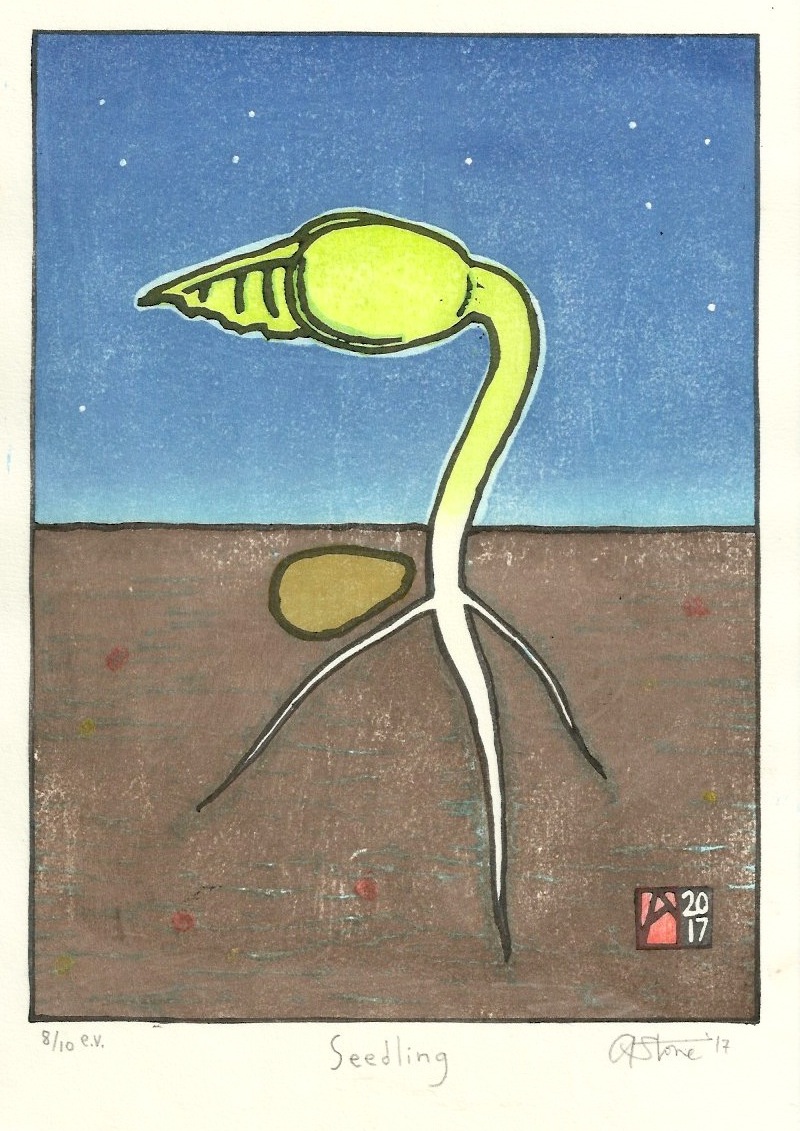
Seedling


There are some plants, pumpkins and squashes, for example, that grow faster at night,  in the hours just before dawn.
And there are some seeds, that without a period of darkness and an absence of light, won't germinate at all.

It is winter and the Solstice has just passed. The shortest day is now history but the nights are still long and cold and I awake to darkness and frost and brittle grass. The winter wheat the neighbors planted went in in November and will put roots down into the cold earth--as they're more hardy in the cold than the other seeds--and will gain a head start that will mean a good crop and grain for bread and pasta in a June and July that are still a distant dream.
Fava beans and peas are also already in the ground and have sprouted but just sit there,  with leaves limp and sad in the cold and damp as they will patiently wait for lengthening days and warmer temperatures to jump up and climb and unfurl leaves and tendrils.

I'm a gardener and therefore an optimist by nature.  But I'm frightened by the wind and chatter now.
Things are changing that the wise farmers didn't see coming.
There are seeds that have been planted for hundreds of years that are now gone, "disappeared" by companies that bought seed houses and catalogs and made them vanish or had them re-patented so they can no longer be saved and sown by the frugal or good farmer.
And they don't tell us but the water is dirtier than it's supposed to be and the air has particles in it that are too small to be measured easily and so are declared "well-below measurable limits".  So even my "organic" garden isn't. No more than anything alive is now free of radioactive isotopes from the atomic tests, bombs and nuclear disasters.
 And now the chemical and oil and pharmaceutical and pesticide and seed and food companies all become one and soon it will be illegal (maybe I'm paranoid) to save seed, or plant "unapproved" varieties, or grow vegetables on unreported plots--and all in the name of "food security" or to fight "bioterrorism".
I watch the news and I read the papers but for the first time that I can remember,  the people in charge want MORE oil exploration and pipelines,  more mining and more ocean drilling but fewer environmental protections for the air and water or labor regulations that guarantee worker and public safety.  They want no regulations to hamper business models that can be profitable only if they can shift the cost of clean up and waste removal to a distant public till and that are instead now encouraged to plunder and multiply while laws are passed that protect them, rather than us,  from liability for environmental damage or pollution.

I have never been a political activist but now I have no choice. I have to join the fight to keep them from poisoning the wells, darkening the skies and making a lifeless, plastic gel of what was once the water of life or stealing the birthright of future generations, the germplasm of all the crops that have ever been sown in soil worked by honest men and women. So I am attending meetings and writing letters and supporting those that are still working to conserve and protect but I will also go back to my little plot of soil.

So I will plant a garden this spring and record in a diary the day the first anemonies flower or the grape buds swell, the day of the first asparagus on the table and the first and last of the English peas.  I will plant some of the old varieties and grow food that the peasants knew and flowers that have different names in different lands. Some we eat, some I draw. As farmers have done for longer than memories can recall, we eat the stunted and challenged plants. For the best plants, strong and defiant, are allowed to set seed are not eaten but saved. They are saved for next year's seed.  We select out the best, the ones that thrived in my soil and today's climate to plant next year and for the year after that, and the one after that, and so on, or so we can hope.
It is dark outside but not yet night.
I wonder what will come up in the garden this year and what will be there to harvest.

Notes; "Seedling" is a moku hanga, watercolor woodblock print. 8.25" x 11.7" and was printed from 4 blocks with 8 separate color impressions on handmade Japanese paper (Shin Hosho). e.v. 10 copies.


.


Thursday, January 12, 2017

Japanese Woodblock workshops in 2017: February in Florence

I'm starting to organize some short and long workshops in moku hanga/Japanese woodblock for 2017.
 My first 2017 introductory class--a 2-day crash course in the basics of watercolor woodblock prints will be held in the San Giovanni School of Art, the cooperative studio I share with 3 other artists on other side of the Arno from the city center.
One of the studios has recently vacated so I have room to host a group with space for at least 6 participants plus room to demonstrate carving and printing.

My February class is now open:
Feb 18 and 19, 10a-6p, limited to 6 students (4 places are still open as of today)
Via San Giovanni 23, Firenze--near Porta San Frediano/Viale Ariosto--easy access to the train station and adjacent (but only intermittently vacant) parking.
€180 for the class includes inscription, materials (2 blocks, paper and pigments) the use of our studio's sharp, student-grade and professional level tools, chisels, and barens for printing.
In addition, the tools used during the workshop: a set of 5 basic knives and gouges, a student baren, and a Japanese stencil brush can be purchased after the class at cost.
Students will be able to print a small edition of a 2-4 color print during this 2-day intensive class.
Email me for information and inscription details at: andrewstone1@me.com

2017 18 & 19 Febbraio: Corso introduttivo di moku hanga--la xilografia giapponese.
Sabato e Domenica 10a-6pm;
Via San Giovanni 23,  L'Accademia d'Arte San Giovanni
Zona San Frediano/Viale Ariosto. Facilmente raggiungibile dalla stazione con l'autobus o a piedi o con i mezzi propri. 
Prezzo del corso e' €180 (€150 corso e €30 materiale: 2 blocchi shina (tiglio japonica), carta, pigmenti e l'uso durante il corso di attrezzi, baren e sgorbie professionale e da studenti del nostro laboratorio.). Gli studenti possono creare il loro stampa di 2-4 colori e stampare una piccola edizione su carta giapponese.   Il docente e Andrew Stone, Americano che da 12 anni lavora principalmente con questa tecnica. Il workshop si svolgera' in Inglese ed Italiano.
Limitato a 6 studenti.
Per inscrizione o informazione contattare Andrew Stone; andrewstone1@me.com
C'e un sconto disponibile per studenti e soci LAILAC.

Coming:
Ravenna (Fall 2017)
Padova (not yet confirmed)
Also I'm hoping to repeat my 2 or 3-day class in Ravenna in October and perhaps teach in a new venue in Padova in late Spring or early Summer. 
Plus I'm getting increasing interest for small sessions (1-2 people)  interested in single day or half-day sessions in the basics---image management and carving, basic and advanced printing, managing registration with multiple blocks, printing an edition with good paper and assistance so I hope to set up a series of day classes with a structured but flexible set of units.

Friday, December 2, 2016

A few more "miracles"--printing variants and one for the dumpster.


This copy is on Magnani incisioni and is my favorite.
I started with just one sheet of Echizen Kozo, a high-quality, pre-sized 100% kozo paper. I got 10 pieces of paper from the one sheet and I also printed several versions onto what was probably Magnani incisioni, an Italian, sized, etching paper.

With just a few sheets and working with multiple thin layers of color, there's a lot of variability to the final prints. I gradually went darker and darker, not sure that I liked them on the pale side, but then looking at the darker ones, I chose not to darken the early ones to make them uniform as I still wasn't convinced.  So in the series, they go from a paler dark blue sky, to a darker pale blue sky with more or less bokashi to the lower field.


The two prints on Magnani incisioni started to resist the color (there may have been a little oil in one of the pigments) and the one I pulled out early--a hazy, glowing light blue/purple/pink version at the top of the page--is my favorite of the lot.  The darker blue one at the bottom had to be blotted as the color sat on the surface and puddled and is a bit smeared--but not really ruined.
The only reject was this one;


I should know better but every now and then I get distracted.

Final tally:

Modern Miracles, (rain for Aleppo).
e.v. 10 and 1 A/P
image is 8" x 6"; paper size is 8"x10".

Tuesday, November 29, 2016

Modern Miracles-Rain for Aleppo


Aleppo, 2016. "Planes are more than birds, and bombs are more than rain," one resident said of the Syrian air force's renewed blitz. (CNN; 11/18/2016).


It is written that Fire and Brimstone fell from the sky and destroyed the cities of Sodom and Gomorrah.
But then it was a wrathful god laying waste to cities populated with only sinners and immoral men and women.  Now we live in a New Age and the men without morals, mercy or a shred of goodness are not to be wiped from the earth but are instead the ones sending the planes and dropping the bombs and the canisters of gas on the sleeping cities below. Today, we don't need holy books to tell us what is happening, as we can watch the bombs fall live on small flickering screens until we turn them off or simply scroll past the images of dead infants, and dust-covered, bloody children and crying men, mutilated soldiers and buildings that aren't buildings anymore. 


I watched the you tube video of cluster bombs falling at night in the Syrian village of Aleppo.
I thought they were strangely beautiful to look at, and they reminded me of the shooting stars my children and I had stayed up late to watch when the Perseid meteor shower occurred earlier this year.  But I knew these were bombs and not meteorites and the footage on the news that followed was horrifying and I was overcome by an incredible sense of shame and helplessness in the wake of image after image of the violence and death being showered on these poor, trapped residents in a city besieged in a modern war by forces with no qualms about the killing of  unarmed residents using chemical weapons or through indiscriminate bombing raids with weapons that will kill large number of civilians as well as their intended military targets. 


**Cluster bombs are weapons that can be ground fired or dropped from aircraft that contain multiple (from as few as 4 to 100's) of smaller explosive devices that spread to detonate over a large area. They are designed to kill multiple troops and to destroy and disable military vehicles but they are plagued by a high failure rate where large numbers of the small and sometimes toylike bomblets do not detonate. It is estimated that 40% of casualties from cluster weapons are civilians, and a large percentage of these are children--during attacks and often after hostilities have ceased. "Cluster munitions pose an immediate threat to civilians during conflict by randomly scattering submunitions or bomblets over a wide area. They continue to pose a threat post-conflict by leaving remnants, including submunitions that fail to explode upon impact becoming de facto landmines. The 2008 Convention on Cluster Munitions prohibits the use, production, transfer, and stockpiling of cluster munitions. It also requires destruction of stockpiles, clearance of areas contaminated by remnants, and victim assistance. More than 115 states have joined the Convention on Cluster Munitions and are working to implement its provisions. Human Rights Watch is a founding member of the Cluster Munition Coalition and contributes to its annual Cluster Munition Monitor report. " (Human Rights Watch).

***The cluster bombs falling on Aleppo are being dropped by both Syrian government and Russian forces (although they both deny it) but these images could easily have been of conflicts in Yemen, or Afghanistan, or Lebanon.
There is an international ban since 2008 on the use of Cluster bombs but countries that make them or have large stockpiles, or use them regularly in conflicts have not adhered to the international accord. While 118 countries have signed the agreement, the USA, Russia, Saudi Arabia, India, Israel, and many other countries are NOT signatories to the accord and continue to make and use these munitions during conflicts.

The last US manufacturer of Cluster weapons has only this year declared that they will stop manufacturing them in 2017 (but will honor existing orders and deliveries) citing among other things, falling demand.


Thursday, November 24, 2016

Blue


 I have a few more layers down, working off two background blocks. There's a very pale carmine bokashi background that went down first, then a pale yellow bokashi and now and then an ultramarine blue followed by another orange glaze.

Rain is expected so I'll be able to escape to the studio and I hope to finish this in the next day or so. 

Probably 2 more color passes to go.